What the ACI EUROPE Annual Congress & General Assembly 2026 told us about aviation’s future
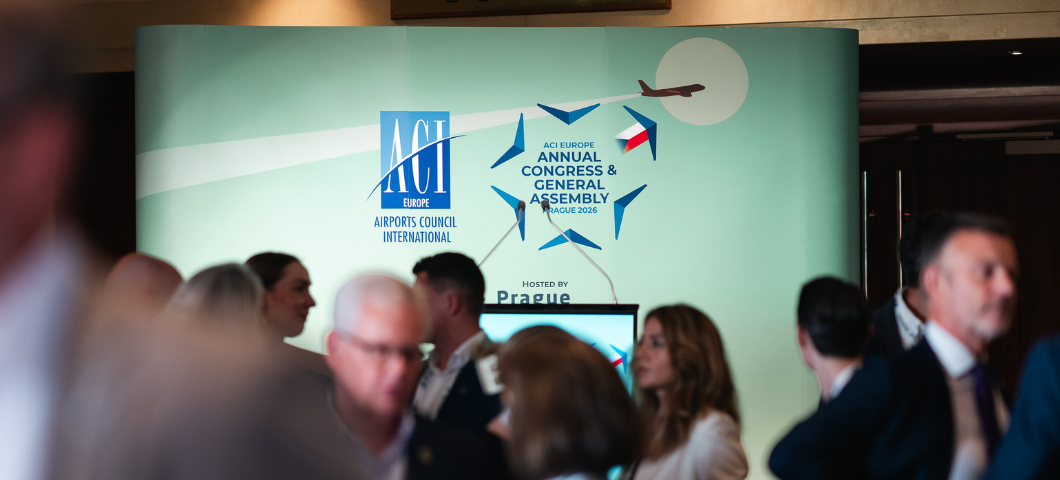
This month saw the most important gathering of airport leaders in Europe, ACI EUROPE’s annual flagship event. Which challenges dominated the conversations, which opportunities generated the most optimism, and what do these discussions reveal about the future of European aviation?
Looking beyond the official agenda, our Five Minute Feature explores the three key takeaways that shaped the conference – with insights from ACI EUROPE’s Policy Directors on what they mean for the year ahead.
1. A brave new world for Europe’s airports
Few in the industry would deny 2026 has been an unpredictable and turbulent year so far – with ACI EUROPE Director General Olivier Jankovec calling it ‘the year of living dangerously’. Yet in his renowned State of the Industry address – a wide-ranging and thought provoking assessment of the European airport industry – it is clear that resilience will be the key definer of success in the coming months and years.
What emerged from Jankovec’s analysis was a stark picture of an industry entering a new era. Whilst passenger traffic has remained resilient, airports can no longer rely on growth alone to secure their future. Rising operating costs, increasing competition for airline business, and the need to invest billions in decarbonisation, digitalisation, security and climate resilience are fundamentally reshaping the airport business model. As Jankovec described it, the industry is facing a ‘Great Decoupling’ – where we must say goodbye to traffic growth automatically funding investment. It is a shift that will require airports to rethink how they generate revenue, prioritise investment and demonstrate their value as strategic infrastructure at the heart of Europe’s economic competitiveness and resilience.
‘What we are witnessing is the end of an economic model that has underpinned airport development for decades,’ states Sergiy Khyzhnyak, ACI EUROPE’s Senior Advisor for Economics.
‘For much of the industry’s history, connectivity, traffic growth and investment reinforced one another in a virtuous cycle. That relationship is now weakening, as airports face rising capital requirements driven by resilience, decarbonisation, and security rather than commercial expansion alone. The economic question is therefore no longer how to accommodate growth, but how to create the conditions that allow airports to remain investable even when growth becomes slower, less predictable and more uneven. How Europe answers that question will have consequences far beyond aviation.’
2. EES disaster on the horizon
Perhaps the most urgent of challenges on the table at the ACI EUROPE Annual Congress and General Assembly was that of the Schengen Entry-Exit System. With ACI EUROPE’s President starkly warning that the situation is becoming ‘unmanageable’ – Europe’s airports are facing a situation that is both outside of their direct ability to control, and yet disrupting their passenger experience, operations, and even safety.
‘The message from Europe’s airports is clear: we cannot accept a situation where the implementation of the EES results in excessive waiting times for passengers,’ says Federico Bounadi, ACI EUROPE’s Director of Facilitation, Parliamentary Affairs & Regional Airports.
‘Such disruption also impacts the wider transport network, damages Europe’s attractiveness as a destination, and ultimately undermines confidence in the regulatory framework itself. The discussions also highlighted a broader challenge: Europe is no longer leading the way in the deployment of airport-operated biometric technologies. While airports in other parts of the world are already delivering seamless, biometrics-enabled passenger journeys at scale, Europe has lost momentum. We now need a policy and regulatory framework that enables innovation and allows our airports to catch up and compete.
I am encouraged by the high-level discussions that took place this week and hopeful they will lead to practical solutions that enhance both the passenger experience and the competitiveness of European aviation.’
3. Net Zero is a point of pride – not just a regulatory task
If there was one area where Europe’s airports projected confidence rather than caution, it was decarbonisation. Leaders in the aviation industry, 328 airports across 38 countries are now committed to achieving Net Zero emissions under their direct control (representing 83% of European passenger traffic.) More striking still, 36 airports have already reached that goal, more than doubling the number from just a year ago, while over 100 are aiming to do so by 2030, two decades ahead of the industry’s collective 2050 target.
The message from Prague was truly unmistakable: for Europe’s airports, decarbonisation is not simply a communications exercise or a regulatory obligation, but a point of pride and a strategic imperative. Their willingness to invest early, set ambitious targets and publicly track progress reflects an industry determined to shape its own future rather than wait for it to be defined or shaped by others.
‘For many years now, Europe’s airports have proven that decarbonisation is at the heart of their operations, and not an afterthought,’ says Alexandre de Joybert, ACI EUROPE’s Director of Sustainability. ‘Each year I’m amazed at the proactive work undertaken in this field. And each year, the bar is raised higher. That’s something all stakeholders contributing to a sustainable future should be proud of.’
Looking to the future
As Brussels Airport is set to host the ACI EUROPE Annual Congress & General Assembly in 2027, and with the hotly-anticipated EU Aviation Strategy a matter of months away, the work continues – the conversations are far from over. ACI EUROPE’s Deputy Director General Morgan Foulkes summarises his experience: ‘What struck me this year at our Annual Congress was the realisation of just how immediately the policy files we deal with at ACI EUROPE are connected to the operational reality of European airports.
Of course, we have always worked on concrete issues with a very real impact on our member airports. But there was generally a gap of several months between discussions at legislative level and the operational reality faced by our members and passengers.
Take the Entry/Exit System, for example. We are discussing it with the European Commission in meetings while, at the very same time, thousands of passengers at our airports are waiting for hours at border control to enter the Schengen Area.
The same applies to biometrics and airport pilot projects in this field, or the certification of aviation security screening machines and their deployment across our airports.
Never before have the files we are dealing with had such an immediate resonance with the operational reality of our members.
What conclusions should we draw from all this? I believe this was very well summarised by Mr Kam Jandu, Chief Executive Officer of AGS Airports Ltd, which operates Aberdeen, Glasgow and Southampton airports in the United Kingdom, during his intervention at our Annual Congress.
Airport CEOs are increasingly required to engage directly with policy files and make the case to local, national, and European decision-makers, in addition to their daily operational responsibilities.
This is a new reality, and a new dimension of our work. It certainly helps explain the interest and enthusiasm among our members in being part of our organisation’s Board.’