Smarter Airports, Stronger Europe: an innovation guidebook for the future
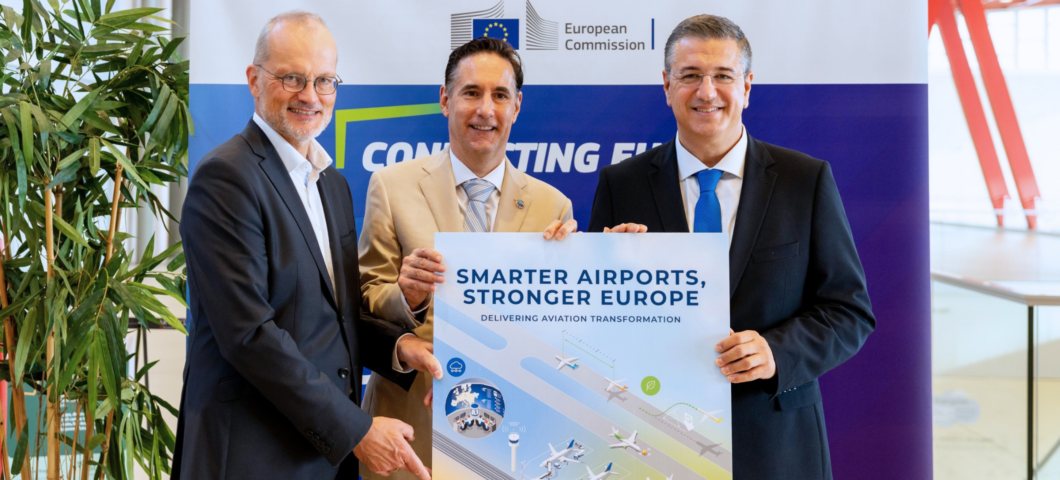
Growing passenger demand, constrained infrastructure, a need for resilience, and a drive to enhance sustainability – these are just some of the industry’s trickiest challenges. Across Europe, airports are already responding with better use of data, digital technologies and collaboration. Now, a new publication from ACI EUROPE and the SESAR Joint Undertaking, Smarter Airports, Stronger Europe: Delivering Aviation Transformation, brings together a selection of some of Europe’s most successful airport innovations and initiatives.
This month’s Five Minute Feature explores how SESAR projects are transforming the aviation ecosystem – and why this new publication is a must-read for anyone looking to take their aviation performance to the next level.
Far from a “what-if” guide attempting to predict future trends, the new publication’s value for airports lies in its collection of case studies, with real examples of innovation happening today. Rather than simply showcasing new technologies, it takes first-hand accounts of those implementing the technology and the practical operational benefits of doing so, offering insights into how airports and their partners are addressing common challenges – and how solutions developed and tested in one operational environment can provide inspiration and a path forward for others.
This unique approach also allows for a bigger picture look at where innovation in aviation is heading. ‘Together, these stories clearly demonstrate that the future of airports depends on a connected ecosystem where innovation delivers greater resilience, competitiveness, and sustainability across Europe,’ states SESAR JU Executive Director Andreas Boschen.
‘The stories in this guide show how that future is already taking shape,’ explains ACI EUROPE Director Olivier Jankovec. ‘Through real airport case studies, they demonstrate how SESAR projects are delivering practical results today, and how they will continue doing so in the future. Whilst each airport’s journey is unique, they all share a common ambition: embracing innovation to improve performance, strengthen collaboration, and enhance the passenger experience.’
The innovations within the publication are presented in a structured approach – with the catalogue of examples placed in three themes: smart, seamless, and sustainable. Below, we highlight one case study from each chapter to pique your interest – and encourage you to read the full publication for even more fascinating examples and knowledge.
Smart: making ground movements safer and more efficient
How is SESAR helping make aircraft movements on the ground safer and more efficient? In the Smart chapter of Smarter Airports, Stronger Europe, we take a look at how lighting can transform airport operations – making them smarter and safer for all involved.
The ‘follow the greens’ SESAR solution uses automated airfield lighting and real-time operational data to guide aircraft along their assigned taxi routes. Particularly valuable in low-visibility conditions, the system helps reduce the workload on air traffic controllers while giving pilots clearer, more intuitive guidance.
The benefits were demonstrated through simulations of Budapest Airport, which showed reduced controller workload, more efficient taxi operations and fewer navigation errors. Pilots also responded positively to the solution, with Hans Christian Erstad, Systems Engineer at Indra, noting that ‘pilots liked the solution as it was simple, safe, and intuitive.’
The innovation has since moved into operational use. A ‘follow the greens’ system is now deployed at Riga Airport also, helping aircraft taxi more quickly and safely in low-visibility conditions: a strong example of how digitalisation can enhance existing airport infrastructure while delivering tangible benefits for both operational efficiency and safety. ‘SESAR helps move from research to real performance improvement,’ concluded Erstad.
Seamless: connecting passenger journeys
One example of SESAR solutions benefiting the entire passenger journey is in the Seamless chapter. The Travel Wise project demonstrates how better data sharing can help airports look beyond the terminal and support the passenger journey from door to door.
At Athens International Airport, the Travel Wise project is connecting aviation, rail and maritime transport through a shared data environment, giving operators greater visibility of passenger movements, transport conditions and potential disruptions.
The benefits are already emerging: greater visibility enables stakeholders to make better-informed decisions on resource allocation and operational planning, anticipate congestion and coordinate responses to disruption. “The ultimate vision is a seamless door-to-door travel experience,” explains Nikos Papagiannopoulos, Head of Digital and Innovation Services at Athens International Airport, with better communication, greater visibility of travel status and a more coordinated transport experience.
The project also demonstrates the value of collaboration across transport sectors. As Papagiannopoulos explains, ‘the partnership between Europe’s Rail and SESAR sends a strong signal that future mobility should be planned and managed as an interconnected ecosystem rather than as separate transport modes.’
For airports in particular, it is a compelling example of how connectivity and data sharing can improve both operational resilience and the passenger experience. ‘Early work has shown that richer visibility into passenger movements and transport conditions enables more informed decisions regarding resource allocation and operational planning,’ concluded Papagiannopoulos.
Sustainable: Turning data into action
The Sustainable chapter highlights another increasingly important area for airports: making environmental data more useful to the people making operational decisions every day.
Environmental performance dashboards being developed through SESAR research are helping bring information on emissions, noise and other environmental indicators into the operational environment. Airports including Prague, Paris-Charles de Gaulle, Paris-Orly, Brussels and Stockholm Arlanda are testing the approach, with each able to focus on its own individual, contextual priorities. ‘Environmental performance and operational decision-making are often managed in separate organisational silos,’ explains Tomáš Vláčil, a terminal operations development manager from Prague Airport.
The objective is to help operational teams understand how their operational decisions can affect environmental performance. As Thomas Bengtsson, PEACOCK Coordinator at Swedavia, explains: ‘The dashboard is designed to give information that could be used in management decisions.’
That means moving beyond measuring environmental performance towards using it to inform action – tailored specifically to the airport’s aims and needs. ‘Paris-Charles de Gaulle is focusing on making the taxi process more efficient, while at Swedavia, we are focusing on reducing delays in the approach process of the aircraft,’ explained Bengtsson.
There is also potential for greater standardisation across airports. ‘An overall standard that can be used by everyone would be a good result from this environmental performance management project,’ says Bengtsson. This is where SESAR’s framework shines. ‘A collaborative framework such as SESAR is essential because it brings together airports, ANSPs, airlines, research organisations, technology providers, and regulators to jointly define common operational concepts, data models, validation methodologies, and interoperability requirements,’ concluded Rubén Martínez Sevillano, a SESAR research partner from Airport Gurus.
Interested in more?
Through the case studies within Smarter Airports, Stronger Europe: Delivering Aviation Transformation, you’ll discover a range of cutting-edge innovations transforming airport operations – and gain knowledge of how SESAR and ACI EUROPE make it happen, with a collaborative spirit that spans the aviation ecosystem.
Discover the full publication now.