Regional airports – resilience, innovation and the road ahead
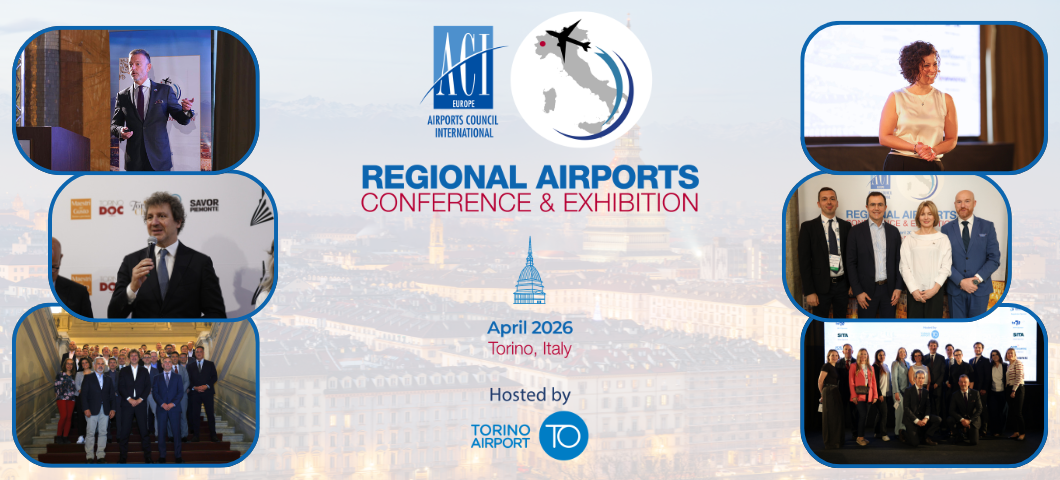
The 17th ACI EUROPE Regional Airports Conference & Exhibition, held in Torino this month, came at a challenging moment for European aviation. Geopolitical turbulence, financial pressure, an airline market more concentrated than ever – and yet, two days later, the regional airport community left with something unexpected: a sense of direction. Here is the story of what happened.
________
Torino, naturally
If you were going to choose a city to host a conference about resilience and innovation, you would be hard pressed to find a better fit than Torino. This is a place that has remade itself more than once: from a royal capital, to an industrial powerhouse, to a creative innovation hub – it was, in other words, exactly the right backdrop.
Host, Andrea Andorno, CEO of Torino Airport and outgoing Chair of the ACI EUROPE Regional Airports Forum, welcomed the European regional airport community with the easy, genuine earnestness symbolic of Torino. The airport’s mission, as he frames it, is simple: to put Torino on the map, and to keep it there. ‘The role of the airport is actually to be connected to the places we like; for people living in Torino to travel around using the airport, as well as putting Torino on the map to be reached by visitors.’
Reflecting on two years as Forum Chair, Andorno was upfront about the crises the industry has navigated and optimistic about what they have revealed – noting that one can only ever appreciate the power of an association when you directly engage. The industry, he said, is alive and kicking. He leaves the chair with that conviction intact.
Piedmont’s Regional Minister Andrea Tronzano set the tone from the opening: regional airports are not secondary infrastructure. They are gateways, growth engines, and the lifeline of territorial cohesion. The message to Europe was clear, and the rest of the conference spent two days making the case in detail.
Putting connectivity, competitiveness and the energy crisis in context
ACI EUROPE Director General Olivier Jankovec delivered his renowned State of the Regional Airport Industry, setting the charter for the day.
The headline figure was good: 2.6 billion passengers across Europe’s airports in 2025 – 100 million more than the year before. However, Small regional airports (those handling fewer than 1 million passengers) remain 33% below pre-pandemic levels – with one airport reporting later on stage that despite doubling their financial incentives to airlines since the pandemic, their passenger volumes and connectivity still remain well below pre-pandemic levels. The post-Covid market has not rebounded as a single entity; it has fragmented, with significant gaps opening between national markets, airport segments, and geographies. Some markets are booming, whilst others are still fighting to find their footing.
2026 was predicted to bring 3.5% passenger growth. That forecast, he admitted openly, has been upended. Conflict in the Middle East, energy market instability, and the threat of renewed cost-of-living pressure have combined to make any projection feel provisional. Demand is holding for now, sustained largely by leisure travellers and those visiting friends and relatives, but the signals are softening. Passengers are cautious: they are spending less, staying closer to home, and booking later.
Within this context, regional airports are particularly vulnerable. Three threats stood out in his address as requiring urgent attention:
The first is the Schengen Entry/Exit System, a rollout that, in his words, is not going well. The image he showed of passengers queuing on the tarmac at Corfu Airport to complete border control registration was not hypothetical; it happened in spring 2026, outside peak season. ACI EUROPE’s position is clear: airports must have the legal ability to fully suspend EES when waiting times become excessive, or the chaos will be real and very public.
The second threat is jet fuel. Europe, Jankovec reminded delegates, relies heavily on external markets for its supply. The closure of the Strait of Hormuz has already reduced tradable jet fuel volumes by around 42%. There are no shortages yet. But the margin is narrowing, and the European Commission has opened a fuel observatory, with ACI EUROPE participating in its advisory work – precisely because the risk is taken seriously at the highest levels.
The third is the investment cycle. Europe’s airports need €360 billion by 2040, not just for capacity but for modernisation, digitalisation, security, and the ESG requirements that are increasingly part and parcel of doing business today. At the same time, revenues are under structural pressure, and costs are rising. Small regional airports are losing an average of €2.6 per passenger. Airports must find ways to decouple their viability from traffic volume alone.
His policy asks were direct: extend operating aid (State aid) for small regional airports beyond 2027, support Sustainable Aviation Fuels and regional connectivity, and suspend aviation tax regimes while the crisis lasts. In particular, the liberalisation of European aviation has been, he argued, one of the best things to happen to regional airports, and calls to reverse it should be firmly resisted.
Three CEOs, three very different stories
The CEO panel brought to life what the numbers can only sketch, and it did so through three voices offering unique perspectives from across regional airports.
Anna Midera, CEO of Łódź Airport and President of the Polish Regional Airports Association, knows the power behind facts and figures. Poland has 14 regional airports, with eight of them operate at a deficit. Together, they handle 65% of the country’s 66 million annual passengers. Even the smallest airport generates around €0.5 billion in economic value for its region. These figures help her illustrate why airline incentives should no longer be framed as charity: ‘I think we should look at it not as incentives, but as an investment for the development of the region.’ And on the subject of low-cost carriers: ‘You don’t ask if you like them. You just need the power to keep the system working, like electricity.’
Philippe Crebassa, CEO of Toulouse Blagnac and Chair of the Lille Airport board, brought a particularly innovative approach to falling passenger numbers, offering delegates real food for thought on how to turn crisis into opportunity. At Toulouse, traffic has fallen from 9.6 million passengers in 2019 to 7.7 million in 2025. The share of low-cost traffic has risen from 50% to 60%. The volume of marketing incentives paid to airlines has doubled, despite lower traffic. His answer has been to move aggressively beyond the aeronautical model: a land bank of over 30 hectares in development for real estate, a solar energy operation that has made Toulouse the largest producer in its metropolitan area, and, perhaps most memorably, a weekly electronic music festival held on the airport’s car parks across three summer months, hosting artists including Carl Cox and Moby. “In three months, this festival generates as much revenue as five retail shops in one year.” The airport, he argued, must become a destination in itself, not merely a departure point.
Enrico Maria Malato, Director General of Trapani-Birgi Airport, made the case for a third path: structural creativity rooted in the very fabric of their operations. Trapani-Birgi is a military airport open to civil traffic, sharing its runway and systems with the Italian Air Force and NATO. This unusual arrangement supports infrastructure costs, enables some of the lowest airport charges in the market, and allows a level of operational efficiency, including non-contact stands and self-manoeuvring aircraft, that translates directly into faster turnarounds and lower costs for carriers. With two Ryanair-based aircraft and expectations of reaching 1.3 million passengers this year, the airport is expanding out of the Small airport category. His broader argument, for cooperation rather than pure competition between Sicilian airports, for viewing shared territory as an opportunity, felt like a quiet manifesto for a different way of thinking about regional aviation.
The panel’s conclusion was honest: regional airports are resilient. But resilience alone will not pay the bills.
State aid: the window is open, use it
The European Commission’s representative, Barbara Brandtner, Director of DG Competition, had a message that was both firm – yet encouraging.
The profitability principle under State aid rules is not changing, she stated clearly. In the European Commission’s opinion, operating aid remains the most distortive form of support and will continue to be treated as exceptional.
However, Brandtner took the opportunity to explain that the upcoming revision of aviation guidelines, due before April 2027, is a genuine opportunity. One significant proposal under active consideration is expanding the catchment area threshold from 100km to up to 200km, which would substantially widen the pool of airports able to benefit from exempted aid without prior Commission notification. The Commission is also monitoring the current fuel and geopolitical crisis with active tools, and may issue further guidance on emergency public service obligations as the situation develops.
The advice was practical: engage. A public consultation will open shortly on the “Have Your Say” portal. The airports that submit evidence, real data, real cases, and real impact will largely shape air connectivity for smaller communities and regions in the years to come – alongside it, their attractiveness and economic resilience.
The LCC conversation: policy matters
Jason McGuinness, CCO of Ryanair, came to Torino with a clear message. Airport and passenger-related charges, airport fees, security, air traffic control, and taxes are, he was clear, the single biggest variable cost that differs between Ryanair bases. Route and base decisions are therefore driven, above all, by what it costs to operate in a given market, with McGuinness noting ‘we will migrate capacity to airports and governments that help us in reducing access costs’.
The examples he chose were pointed. Germany and Austria, dragged down by excessive aviation taxes, have seen capacity leave: for example, the Berlin base has closed, and traffic has migrated from Vienna to Bratislava. Sweden, on the other hand, removed its aviation tax and received a surge in capacity in return. He also noted the competitiveness of the market, including how many airports have directly contacted McGuinness to secure the relocation of the aircraft pulled out from Berlin.
His message to regional airports was, in the end, a simple offer: keep costs low, operations reliable, and conditions predictable, and Ryanair’s growth, which targets 300 million passengers by the early 2030s with a young and fuel-efficient fleet, will find its way to you.
Route development: the table needs more chairs
The route development panel arrived at a conclusion that felt less like a discovery and more like a long-overdue acknowledgement: no airport can develop a route alone.
Wizz Air and ITA Airways were clear: geopolitical risk and fuel volatility are now built-in constraints on network planning. Capacity moves faster, weak routes are cut quickly, and new routes need strong data-driven cases with real risk-sharing. Subsidies without a path to sustainability are no longer viable.
Hermes Airports Ltd, Toscana Aeroporti and Fraport Bulgaria are rebuilding incentive models, shifting from summer volume to year-round commitment, winter capacity and new markets. Hermes also showed how rapid-response operations protected connectivity during geopolitical disruption.
The key point: route development now requires broader partnerships. Tourism bodies, municipalities and local businesses provide the market insight, funding and backing needed to sustain new routes beyond the first season.
The afternoon: proof that small can move fast
If the morning sessions were about diagnosing the challenges, the afternoon was about demonstrating that something is already being done, and that, more often than not, it is being done first at regional airports.
Kicking off the afternoon programme, Torino Airport’s COO, Lorenzo Gusman, and Carbon Management and Energy Innovation Manager, Gabriele Restaldo, opened with TULIPS, an EU-funded consortium project that has positioned the airport as a first-of-its-kind smart energy hub. The system combines solar generation, an electrolyser, hydrogen storage and fuel cells using multiple gas blends. Surplus solar power is converted to green hydrogen, stored and used to power airport infrastructure. Performance data and operational lessons were shared openly. The argument the speakers made was one that the room was ready to hear: regional airports do not need to be large to lead on decarbonisation. They need to be bold enough to go first.
The Dragon’s Den innovation session brought four very different examples of that same principle. Aena has been using its network of regional airports as a laboratory: autonomous boarding bridge controls, drone-based airfield inspections, smart queue guidance systems, all trialled at smaller airports before being considered for the major hubs. Cork Airport presented a suite of pragmatic, data-driven improvements that have quietly transformed its operational performance: advanced security rostering, Power BI dashboards, AI-powered passenger measurement, and smarter car park management. Torino Airport demonstrated a ground access dashboard that combines CCTV analytics and parking data to understand how passengers arrive, support new public transport services, and quantify Scope 3 emissions, contributing directly to higher Airport Carbon Accreditation levels. Warsaw Radom Airport introduced Flyport, an interactive edutainment centre inside the terminal, alongside an industry-led skills centre, turning the airport into something that serves its community seven days a week, not just when flights are operating.
Right after that, Roboxi and Toscana Aeroporti made perhaps the afternoon’s most visually striking case: autonomous robots, developed by Roboxi and currently in proof-of-concept at Florence and Pisa airports, patrolling runways and taxiways for foreign object debris. The aviation industry loses tens of billions of dollars annually to FOD, bird strikes and runway incidents. The Roboxi system, equipped with AI, computer vision, and real-time communications, has already logged nearly 200 operating hours, over 1,000 operational jobs, and a detection rate of approximately 70%.
Non-aeronautical revenue: stop renting, start hosting
The final session of the conference addressed a transformation that has been underway for some time but is now, increasingly, defining success in an era in which airports must decouple financial viability from volume growth.
Speakers from Munich Airport, Fraport Greece, Lithuanian Airports and retailer Gebr. Heinemann were aligned on the diagnosis: non-aeronautical revenues now represent 40–60% of total revenue for many airports, and an even higher share of profit. The airports performing best in terms of commercial income are not the ones with the most sophisticated lease agreements. They are the ones that have stopped thinking like landlords and started thinking like hosts.
That means taking passenger segmentation seriously: knowing and understanding passengers and sharing data with partners to optimise conversion matters. Unlocking Gen Z hearts and wallets? Experiences, events, and emotion-led commercial activities resonate with younger audiences. Panellists also noted the success of making the local identity of a place a key focal point: turning Greek products, Lithuanian nostalgia, Bavarian food culture, into something that is not just atmospheric decoration but a genuine commercial proposition. And it means moving from rigid minimum-guarantee contracts toward dynamic partnerships where airports and operators share both the risk and the upside, co-invest, co-create and learn together.
The session closed with a thought that deserves to travel beyond the room: revenue is the result of remaining interesting. Build something worth visiting — a retail environment, a food offer, an experience — and the numbers follow. Chase percentage targets in isolation, and passengers may walk past everything on their way to the gate.
Looking ahead: Iași, Romania
The 17th ACI EUROPE Regional Airports Conference & Exhibition ended with an announcement: the 2027 edition will take place in Iași, Romania. Gateway to Moldova, a city that knows something about being on the edge of Europe and insisting on its place within it.
________
Two days in Torino produced no shortage of bold conversations and sharp insights. But RACE 2026 also produced something harder to quantify: the collective resolve of a community that is still here, still growing, and still finding ways to make itself indispensable.
As Andrea Andorno put it, looking out at a room that was very much alive: the industry is well and kicking. Torino showed it. Iași will be next.