How did European airports perform in 2025? Airport Punctuality Network provides insights
Following a strong performance in 2024, European airports continued to improve their arrival and departure punctuality in 2025, helped by more favourable weather and reduced ATFM delays in the summer.
For the full year of 2025, at the 30+ airports part of ACI EUROPE’s Airport Performance Network, 76.0% of flights arrived and 70.2% departed on-time, this was an improvement when compared to 2024, where arrival punctuality was 72.3% and departure punctuality was 65.8%. The delta between arrival and departure punctuality has narrowed, highlighting the work done at airports to enhance turnaround resilience and performance:
| 2024 | 2025 | CHANGE yoY | |
| Arrival PUNCTUALITY | 72.4% | 76.0% | +4.97% |
| DEPARTURE PUNCTUALITY | 65.8% | 70.2% | +6.69% |
| delta | 6.6 | 5.8 |
The growth of European air traffic in 2025 was 4.1%. This growth was supported by consistently strong daily activity, with the network averaging over 30,000 flights per day, and by a summer season that reached an average of 35,122 flights per day, up 3% from summer 2024, translating to 11.1 million flights in the network in 2025.
In terms of what causes delays, the main cause of delay remains reactionary (i.e. knock-on) delay, with airline-related delay ranking second. Airport-related causes remained stable in 2025, again highlighting the work done by airports to optimise performance – a result of the increased collaboration between all airport stakeholders and better sharing of data, such as through the initial Airport Operations Plan – while remaining vulnerable to the factors which result in reactionary delay.
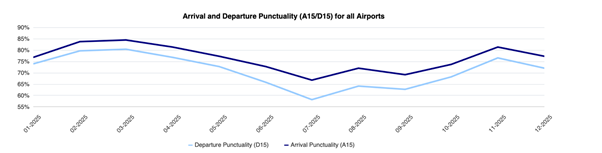
In July, the month with the lowest levels of on-time performance, punctuality was nonetheless higher than in the same month in 2024, and with a smaller delta between arrival and departure punctuality:
| JUL 2024 | JUL 2025 | CHANGE yoy | |
| Arrival PUNCTUALITY | 62% | 67% | +5% |
| DEPARTURE PUNCTUALITY | 51% | 58% | +7% |
| DELTA | 11 | 9 |
The better summer performance, drawing on increased operational resilience and favourable weather, was indicative of the improvements made this year. Nonetheless, it also demonstrated that the problems faced in the summer peak are not isolated to those few months, but rather are drawn into sharper relief at the busiest time of year.
ACI EUROPE’s working bodies on performance and punctuality matters – the Airport Punctuality Network and the Airport Performance & Capacity Steering Group – will be addressing two issues in particular this year, namely early arrivals and turnaround resilience. Both these matters affect the overall performance of the airport and the wider airspace network, with clear implications for passengers and the resilience of the airspace network.
Early arrivals may seem like a good thing, especially for the passengers who on landing envisage additional time for sightseeing, to get to their meeting or make their connection. However, we all know the feeling of that bubble bursting as the captain announces that the aircraft will have to wait on the tarmac until a stand becomes available, as its previous occupant hasn’t left yet, or the ground crew are simply not there, having planned their operation in accordance with flight schedules.
This inconvenience, however, goes far beyond the feeling of missing out on a bit of extra lounge time. For the airport operation, aircraft arriving too early mean additional strain on resources and capacity. Ground staff are required to choose between getting another aircraft away on time or diverting attention to the early-arriving flight, border and security checkpoints may not be adequately resourced, and flights which were themselves delayed may find themselves being overtaken in the air by another aircraft which was too early.
From a sustainability standpoint, early arrivals tend to “shift” inefficiency, not remove it: extra vectoring or holding, extended taxi-in times with engines running, and avoidable APU usage while waiting for a stand – all add fuel burn, emissions (CO₂ and NOx), and noise. In the morning peaks, earliness can also push operations closer to night-noise restrictions and increase community disturbance.
Resolving the issues created by too-early arrivals will require collaboration and exchange between airports, airlines, ground handlers, ANSPs and the Network Manager – in Europe as well as elsewhere, such as the FAA and Nav Canada, given the prevalence of North Atlantic flights arriving ahead of schedule in the morning.
Enhancing turnaround resilience also presents similar challenges in terms of stabilising and further narrowing that delta between arrival and departure punctuality. The airport operation should be able to receive an inbound aircraft and prepare for its next punctual departure while withstanding any contingencies which may occur. This again requires advance planning and collaboration between stakeholders, as well as strong tactical information sharing. Furthermore, it requires a focus on resilience throughout the operation, whereby normal demand can be absorbed, constraints accommodated and any backlog cleared with minimal knock-on impact. Realistic turnaround times will be one of the most contributing factors to increase the turnaround resilience.
We will be carrying out extensive work on these topics in 2026, including the development of a discussion paper on early arrivals and continuous outreach to other stakeholders including airlines, ANSPs, ground handlers, slot coordinators and the Network Manager. Furthermore, the upcoming roll-out of ACI EUROPE’s Performance KPI Platform will enable all airports who are members of the APN to share and compare their performance across a range of indicators along the inbound, turnaround and outbound process. With these actions as a basis, airports can lead the way in ensuring that on-time performance is resilient, predictable and able to further improve in the years ahead.