From research to reality: how Europe’s projects are driving aviation sustainability
Across Europe, a variety of EU airport projects and consortia are helping to deploy aviation sustainability research, from demonstrations to implementations – one step at a time.
In this month’s Five Minute Feature, we bring you an in-depth look at four such projects: ALIGHT, OLGA, Stargate, and TULIPS. Join us to discover how these projects are providing bold, innovative ideas – tested in real airport environments – and scaled through European partnership.
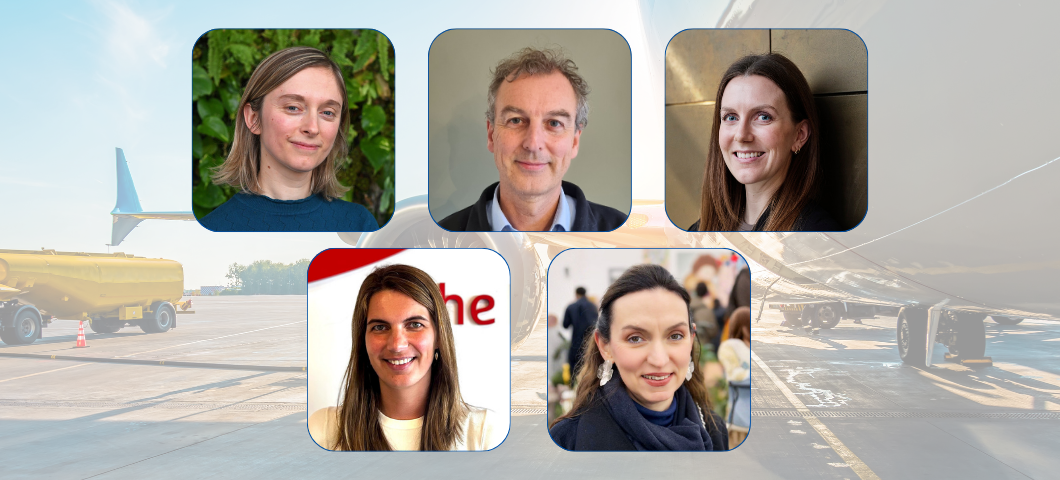
With each project having a variety of different aims, we ask each project to provide an ‘elevator pitch’ to bring readers up to speed. Charlotte Verreydt of Brussels Airport, representing Stargate, notes a precise aim: ‘We try to develop, test, and deploy innovative solutions,’ she notes. ‘Stargate is one of three European Green Deal airport projects, with 22 partners inside and outside aviation, all aiming in their own way to make the European aviation industry more sustainable.’ For TULIPS, represented by Fokko Kroesen from Amsterdam Airport Schiphol, they aim to provide a roadmap of practical guidelines for European airports to achieve net zero emissions – ‘with a total of 17 successful demonstrations, to be included in a roadmap for EU airports,’ Fokko adds. Ayce Celikel from ENVISA and Virginie Pasquier of Groupe ADP represent OLGA: defining OLGA’s mission as ‘accelerating the aviation sector’s transition to climate neutrality and environmental performance through 40+ real-world demonstrations.’ Last, but not least, Louise Krohn from Copenhagen Airport summarises ALIGHT’s mission: ‘to showcase how large international airports can become lighthouses and lead the way towards climate-neutral operations, through the deployment of SAF and smart energy solutions.’
From paper to action
Yet, how do these projects bring these aims off-paper and into the hands – and operations – of European airports? One way to do so is through demonstrations, which are a fundamental part of showcasing projects’ research. For TULIPS and ALIGHT, successful demonstrations are a hallmark of their success. ‘For ALIGHT, the ‘short-term measurement campaign’ demonstrated the impact of SAF on local air quality,’ Louise notes of the ALIGHT project. ‘An extensive and complex analysis of local data points – designed around a dedicated aircraft route – revealed a 30% reduction in ultrafine particles when the aircraft used a 34% SAF blend, proving a significant improvement in local air quality.’ For Fokko and TULIPS, demonstrations also brought about use case evidence. ‘The demonstration of energy storage and servicing eGPUs with an Iron Flow battery proved very successful. It taught us how to optimise energy use patterns with heavy-duty electrical equipment in an operational setting.’
Overcoming obstacles
And yet, such demonstrations can bring about obstacles and large mountains to climb – for both OLGA and Stargate, external factors required creative rethinking. Virginie reports on Olga’s need to adapt: ‘One of our most valuable pilots was the Reusable Cups initiative at Paris CDG Terminal 2BD during the Olympics. We successfully deployed 20,000 reusable cups and gathered critical real-world data. The results established a key viability threshold: while we achieved a 50% return rate, our analysis showed that the business case requires a 90% return to be economically sustainable. This finding is now informing industry-wide circular economy strategies.’
For Charlotte and Stargate, a similar kind of rethinking was required. ‘When we wrote our proposals in 2020, it was a different world, almost. At that time, we planned a large-scale SAF blending facility because the pipeline could not yet transport SAF, so on-site blending was the only option. With a SAF mandate now in place and SAF moving through the pipeline, large-scale blending is no longer justified. However, there is still value for specific cases – such as remote airports or private aviation – and this reflects how both the market and regulation evolve, and how we must adapt to continue achieving our objectives and delivering value for the industry. Therefore, we have adapted the scope to small-scale blending, which will be tested next year. During this test project, the impact of SAF on the surrounding air quality will also be measured.‘
Surprising findings
Amongst the challenges – and successes – one thing always arises: rich research for the airport community on decarbonisation. But what was each project’s most surprising finding? For OLGA, ‘how much untapped potential there is when airports adopt a truly integrated environmental approach and multistakeholder collaborative work,’ Virginie explains. ‘Across mobility, circularity, hydrogen, lighting, biodiversity, and air quality, we repeatedly discovered that small operational changes – supported by good data – can create much larger environmental benefits than expected.’ Charlotte observes that Stargate has revealed a mismatch between the industry’s desires and what is mature in the market: ‘it has become very apparent that there is a lot of willingness within the industry to decarbonise – be it airports or airlines – but we still notice there’s limited offering in the market.’ For Louise, there are key findings for each workstream – but in summary, ‘fuel quality variations significantly affect local emissions – and holistic energy systems deliver unexpected resilience benefits.’ For Fokko and TULIPS, almost all CO2 benefits were related to Scope 3 emissions – ‘this means we need strong cooperation with all Scope 3 partners to achieve the desired results,’ he explains.
Collaboration as an asset
While the projects have diverse aims, stakeholders, and methods, they’re all well aware of their shared environment and use it to their advantage. ALIGHT and OLGA found significant value in a joint approach: ‘We have a great collaboration with our sister projects Stargate, OLGA, and TULIPS. Joint challenges require joint solutions, and these projects have contributed significant value to ALIGHT,’ Louise explains – whilst Virginie notes the joint KPI workgroup was ‘fundamental’ to the four project’s collaboration. Both TULIPS and Stargate, too, note the joint KPI approach has been fruitful – ‘aligning our performance monitoring to enable joint tracking and synthesis of results in the final stage,’ in Fokko’s words, created the success Charlotte describes as an ‘immense help with final reporting and for creating a benchmark for researchers to compare results.’
Reflecting on achievements
As these projects come to an end, what do they consider their proudest achievement? While the specific outcomes of each project differ, it is clear that they share the same sentiment: pride in delivering real, tangible benefits to aviation. OLGA have produced a number of solutions that provide measurable reductions in energy consumption, as well as unifying data regarding air quality – with ‘the Air Quality Platform’s TRL 7 status and proven replicability mean it is ready now to become the standard monitoring and decision-support tool for European airports,’ Ayce explains. Louise is enthusiastic about ALIGHT’s ‘ground-breaking measurement campaigns, including the short-term measurement campaign, which stands out as, to our knowledge, the first of its kind conducted in a fully operational airport environment,’ whilst for TULIPS, ‘a strong network across Europe where we respect each other’s contributions and ways of working’ proudly shines.
For Charlotte and Stargate, the impact is particularly personal: ‘one of our projects within Stargate, the autonomous mobility shuttle, became part of Brussels Airport’s Saint Nicholas day celebrations. Staff, including me, were able to bring their families to ride the shuttle. It was a real full-circle moment to travel with my son on board this shuttle, and know my work is inspiring future generations in aviation.’
Looking to the future
What now? The projects might be ending, but their impact on the industry remains. Projects like OLGA have consolidated their results to ensure that the developed technologies can be industrialised and replicated in fellow airports – including a full exploitation and technology-transfer framework, a structured catalogue of 40+ exploitable innovations, and business models for long-term deployment. ALIGHT, too, have developed a ‘Replication Toolbox’: ‘designed to enable airports across Europe to replicate the solutions, methodologies, and lessons learned from ALIGHT in their own contexts,’ Louise explains. For TULIPS, Fokko believes several demonstrations have the ability to support long-term aviation decarbonisation: ‘Actually, this is a close call across several domains. I believe the energy transition solutions are particularly promising – from hydrogen use in heavy-duty equipment and green energy storage with smart grids at airports to the mid-term upscaling of SAF, where various technical and logistical barriers still need to be addressed. I’m looking forward to the final sprint to assess the potential of our solutions and those developed by other Green Deal projects.’
Charlotte takes a broader view: ‘there might not be one silver bullet for decarbonisation, but if all these projects teach us anything, it is that it will take a huge amount of innovation and effort from the industry to overcome this challenge. It’s why I’m grateful for the opportunity to be part of projects like Stargate, OLGA, ALIGHT and TULIPS – to create awareness and discover new opportunities.’

Find out more about ALIGHT here.
Find out more about OLGA here.
Find out more about Stargate here.
Find out more about TULIPS here.